
B2B SEO: A Practical Strategy for Long Sales Cycles

SEO consultant & Google Ads specialist
A management consulting firm in Amsterdam ranks number one for “organizational restructuring consultant” — a keyword with 250 searches per month. That single page generates six to eight qualified calls every month that may each be worth a potential five-figure contract.
Their marketing team doesn’t even track traffic, just the calls.
This is a hypotethical example, but it illustrates well the reality of B2B SEO: the math is very different from consumer marketing. It’s not about chasing pageviews, but rather placing your expertise in front of a small number of decision-makers at the moment they’re researching a problem you can solve.
Too many B2B companies approach SEO one of two ways: They ignore it entirely (“our customers don’t find us via Google”), or they apply consumer tactics that generate traffic from people with no intent to ever buy anything.
In this no-nonsense guide, we will cover a third option, namely how to build a B2B SEO strategy that generates pipeline, not pageviews.
How is B2B SEO Different from B2C?
It’s not just the search volumes that differ. In B2B SEO, you usually have to take a much wider approach to being present in your customer’s research process, during multiple stages in their buying journey.
Said journey is fundamentally different from consumer behavior. It’s hardly ever about optimizing for someone’s impulse decision. More likely, you are dealing with an expert buyer that researches over weeks and months, taking multiple stakeholders with different priorities into account.
This affacts what keywords you target, the types of content you create, how you measure results, and how patient you have to be.
Buying cycles are longer and involve more people
The typical B2B purchase involves six to ten stakeholders, according to Gartner’s B2B buying journey research. These buyers collectively spend the largest share of their time researching independently online, before talking to salespeople. When they do speak with sales, opinions are already formed and probably strong.
There is no single piece of content that drives the decision. Your website needs to cater to all potential stakeholders in the chain, ranging from a CFO evaluating ROI or an IT manager assessing integration requirements, to an end-user checking for features. This might happen at completely different points in a process that spans months.
Search volumes are low — but intent is high
“Best running shoes” peaks at around 100,000 searches per month. “Enterprise fleet management software” gets around 100. But a single fleet management software contract might be worth €150,000 annually.
In other words, low search volume is not the same as low value. In the B2B space, a keyword with 300 searches per month could have more commercial value than a consumer keyword with 300,000. Applying B2C SEO logic to B2B points you at the wrong keywords.
Attribution is broken
Adding to the difficulty of B2B SEO is the fact that attribution can be borderline impossible. To illustrate, let’s say there has been a security breach: this triggers the CISO searching for “endpoint protection solutions,” whereas the IT manager searches for “how to deploy EDR software.” Later, the CFO searches for “cybersecurity solution ROI.”
All three are effectvely one customer but the search behavior is fragmented.
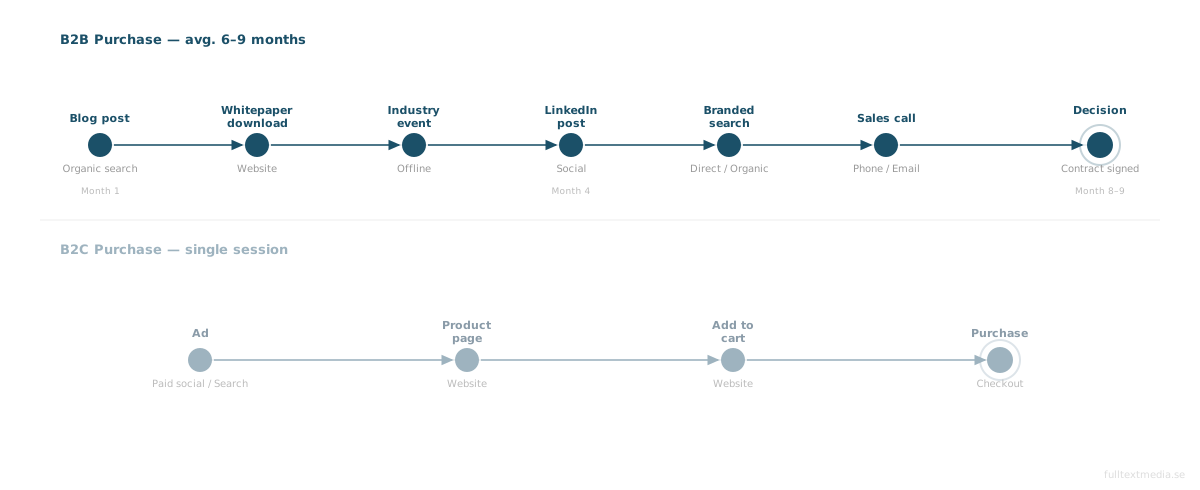
One B2B buyer might read your blog post in February, then download a whitepaper In April. In June, the buyer stumbles across your LinkedIn post, which leads to a website visit (via branded search) to fill out a contact form.
The branded search gets all the credit, even if it was the least influential.
You can probably see the pattern: B2B SEO is systematically undervalued since standard analytics makes it invisible.
Example: A B2B SEO Strategy in 7 Steps
These steps build on each other and skipping some makes the others less effective.
Step 1: Map Your Buyers’ (Search) Behavior
Understanding buyer behavior comes before keyword tools. Start by defining your Ideal Customer Profile (ICP): the industry, business model and other characteristics of your ideal customers. Within that ICP, who would be the actual person(s) involved in a purchase decision?
For a company selling mid-market HR software, there would be multiple roles involved.
| Role | Core concern | Example search | Content needed |
|---|---|---|---|
| HR Manager | Day-to-day efficiency | ”automate employee onboarding process” | How-to guides, workflow examples |
| IT Manager | Integration and security | ”HR software API integration” | Technical documentation, security overview |
| CFO | ROI and total cost | ”HR software cost per employee” | ROI calculators, case studies with numbers |
The dark funnel: What your analytics doesn’t capture. Forrester research has found that B2B buyers tend to be well into their evaluation process before they contact any vendor. They have researched online by reading articles, comparing, forming shortlists and so on – none of which shows up in your CRM.
SEO is part of that invisible research phase. The blog post someone read half a year ago could be what gets you on the shortlist. It doesn’t show up in analytics but it surely matters.
A practical starting point (again, before opening any keyword tool) could be to interview recent customers. Ask them openly about what they were searching for what they found. What factors made them choose you over a competitor?
Step 2: B2B Keyword Research — Think in Layers
Normal keyword research practice is finding terms with solid search volume and manageable competition. But with B2B keyword research, you neet to take into account the longer buying process and the extra dimensions it adds to behavious.
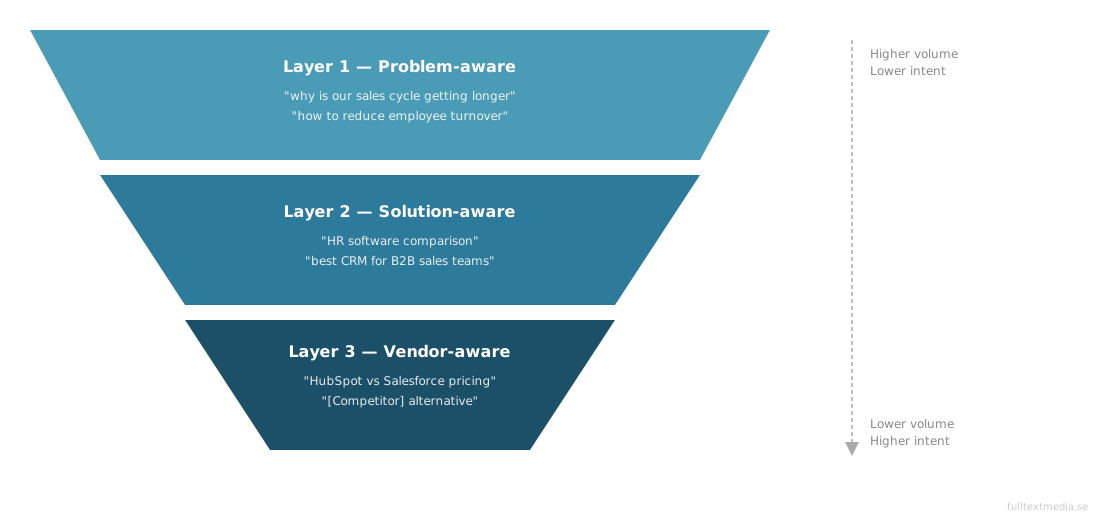
Layer 1 — Aware of a Problem Here, the buyer knows something is missing but hasn’t identified the solution yet.
- “why is our sales cycles getting longer”
- “how do we reduce cost of employee turnover”
- “our supply chain software feels outdated”
These searches are probably low on exact-match volume, but are also where a buying journey begins. Is it addressed by your existing content?
Layer 2 — Solution-aware Eventually, the buyer knows there exists a solution exists and is actively researching options.
- “HR software comparison”
- “best CRM for B2B sales teams”
- “ERP vs custom development”
As you know, there’s plenty of B2B content to meet demand here and there is no doubt competition.
Layer 3 — Vendor-aware When the buyer is evaluating specific products/services.
- “[Competitor] alternative”
- “[Your company] vs [Competitor]”
- “[Product category] pricing”
Search volumes may be more moderate here but the purchase intent is high.
How to research each layer:
In the first layer you could think like a buyer with a problem. Search for your customers’ problems phrased like “why does X happen,” “how to fix X,” “X keeps happening.” Check Google’s People Also Ask boxes are your best friend here – especially since searches don’t necessarily appear in keyword tools at all, but nevertheless exist in various forms.
For the other two layers, use your usual keyword research tools, e.g. Ahrefs, SEMrush, or Google Keyword Planner. Also Search Console if you already have rankings. Taken together, these will helo you find category terms, comparison queries, and competitor-adjacent searches.
On volume: A keyword with 80 searches per month with a strong potential to convert is worth building content for. The question is not just “how many people search this?” but also: “when someone searches this, how close are they to buying something I sell?”
Step 3: Map Keywords to Your Sales Funnel
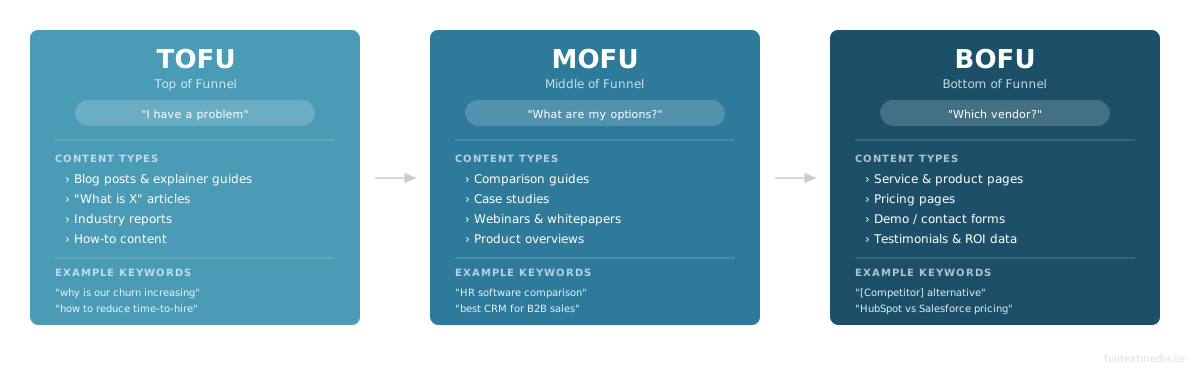
With all the right keywords in hand, map them to your sales funnel stages to ensure you have content serving buyers at every stage.
| Funnel stage | Buyer mindset | Content types | Goal |
|---|---|---|---|
| Top (TOFU) | “I have a problem” | Blog posts, explainers, industry guides | Awareness and discovery |
| Middle (MOFU) | “What are my options?” | Comparisons, case studies, webinars | Consideration and trust |
| Bottom (BOFU) | “Which vendor?” | Service pages, pricing, demo requests | Conversion |
The most common gap in B2B SEO: Companies over-invest in BOFU content such as product pages, contact forms, feature lists, while passing on TOFU or MOFU content. The result is a website that’s invisible to the most potential buyers who aren’t ready to convert yet.
Forrester research shows B2B buyers prefer to self-educate before engaging sales. If your content isn’t present during that phase (i.e. TOFU and MOFU) you might not get considered.
Step 4: Optimizing Your Core Service and Product Pages
The BOFU pages, where buyers go when they’re potentially ready to convert, are of course extremely important in terms of both rankings and revenue.
SEO fundamentals:
- Title tag: primary keyword near the start, less than 60 characters
- Meta description: benefit-led with a clear value proposition, under 155 characters
- H1: matches title tag or is a close variation
- URL: clean, with no extra parameters or session IDs
- Internal links from related blog content into these pages
What generic SEO guidelines often miss:
In B2B, your service pages aren’t just landing pages for organic traffic. They’re the pages a skeptical CFO reviews before approving a demo request, and need to answer the right questions and address concerns.
Social proof that’s specific: Client logos are good, but case studies with concrete numbers are great. “Reduced problem X by 40%,” “cut annual Y from 600 to 80.” Same goes for generic testimonials over specific outcomes for recognizable companies.
Content for multiple roles: Consider secions or callouts that speak directly to specific stakeholders. The IT manager needs to know about security and integration. The CFO needs to see a business case, while the end user needs to understand what daily use looks like.
FAQ that answers actual questions: Google is no longer considering FAQ schema for inclusion in featured snippets (at least not for marketing pages), but FAQs still have a role to play. A valid approach is replicating the questions that your sales team often answers on first contact. They are there to reduce friction and address objections before they form, or simply to qualify leads before they reach out.
Step 5: Build Topical Authority (Yes, it Exists)
You may have heard that “Google ranks individual pages,” but when looking at the real world, it’s obvious that topical authority factors in. Ranking for meaningful B2B terms on a new or low-authority domain is hard, and is unlikely to happen with just a few well-optimized pages. Topical authority means that your website covers a subject more comprehensively and reliably than alternatives.
There are many names to describe a similar process of building topical authority. We will call it the content cluster model.
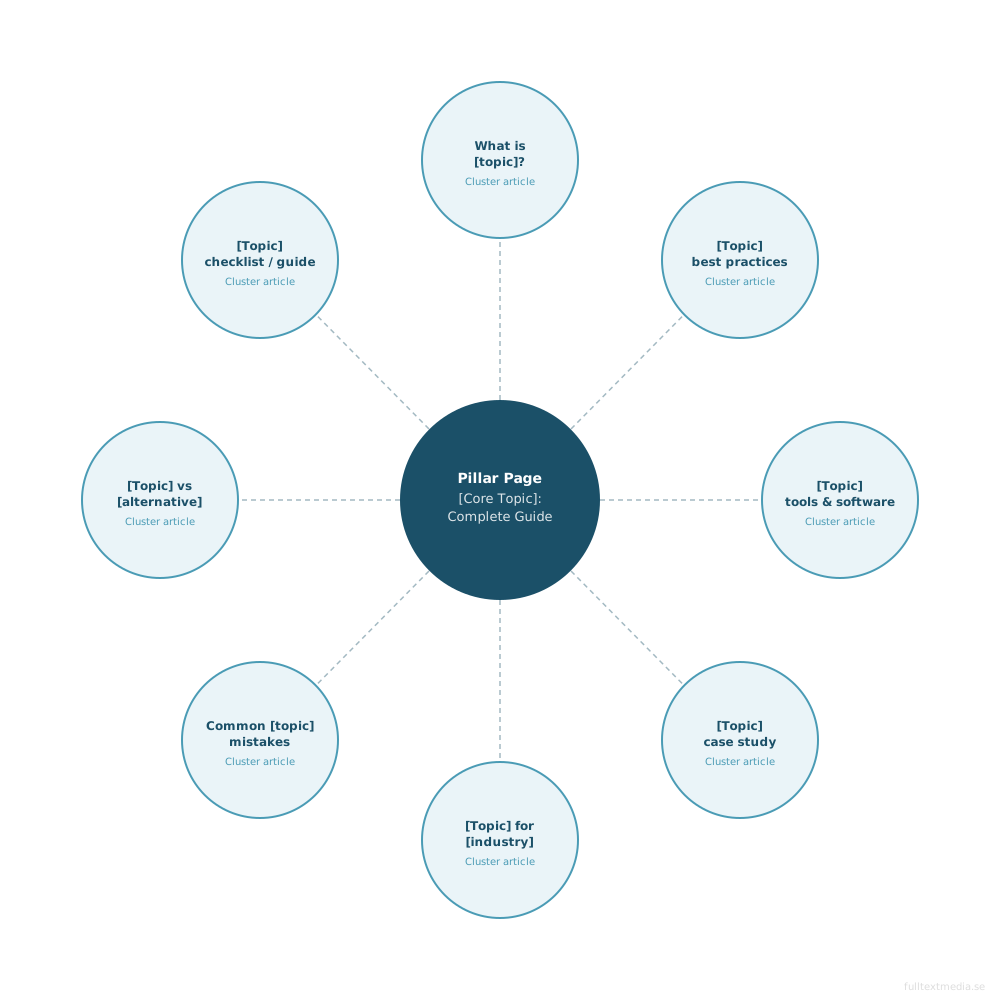
A pillar page: A comprehensive overview of a core topic, e.g “B2B Lead Generation: A Complete Guide”. This page will be a key focus of link building and should cover a topic broadly.
Cluster articles (8–12): These pieces are deep-dives on more specific topics, e.g. “LinkedIn Lead Generation for B2B,” “How to Build a B2B Newsletter,” and so on.
Internal linking: Needless to say, internal linking between the main pillar page and cluster article should be liberal. When done properly, it sends a signal to Google and users alike that your site is a hub of expertise on the chosen topic.
Why this matters: There are pleny of actual knowledge gaps in many B2B industries. Serving expertise in topics like cold chain logistics, construction project finance, or medical device compliance will stand out against content farms that can’t cover the topics with any credibility.
Make the most of limited resources: You don’t need to publish everything at once (even the biggest industry names rarely do). Build the cluster with one article per month and you will have a full cluster in 12 months.
Step 6: Don’t Forget Technical SEO
Technical SEO essentially means having a well-oiled infrastructure. No one notices when it works, only when it doesn’t. The factors are mostly the same for any website, but some issues come up more often in B2B.
Core Web Vitals: B2B websites often accumulate lots of heavy pages over time, such as resource libraries, embedded PDFs, product demo videos etc. Google’s Core Web Vitals — especially Largest Contentful Paint (LCP) — measure how quickly your most important content loads. An LCP under 2.5 seconds is an important target. Use PageSpeed Insights to identify pages what needs work.
Gated content and indexation: Content behind a registration form can’t be indexed by Google. This doesn’t mean un-gate everything, but make sure to publish ungated, indexable content covering the same ground at a high level, with a link to the full gated version if that’s a must.
Multilingual sites: When selling across multiple markets, make sure that your hreflang tags are properly implemented. This is usually fairly simple to implementat but has a meaningful effect.
Schema markup to consider:
- Organization (site-wide): establishes your entity in Google’s knowledge graph
- Service (each service page): describes what you offer
- BreadcrumbList: improves navigation display in results
Step 7: Link Building for B2B
Backlinks are still the most important ranking signal. What might be diffent in the B2B space is that there are often overlooked link-building opportunities such as:
Industry publications: Most B2B verticals have specialist publications and/or association websites. Contributed articles are not just about SEO but also a great way to get in front of exact target audience. But don’t forget about the backlink.
Supplier and partner directories: Suppliers, resellers, and other partners linking to you is often mutually beneficial and requires little effort. Getting a listing with a link from relevant partner websites is also a lot more valuable compared to generic directory links.
Industry associations and certifications: Being a member in industry associations often earns you a directory listing. Same goes for relevant certifications.
Original research and data: The evergreen link-building strategy is producing content others will want to cite. In B2B, this could mean surveys, benchmark reports, or just a novel spin on publicly available data. LinkedIn’s B2B Institute regularly publishes original research that gets widely cited.
Commentary in media: Journalists often need expert sources. HARO connects journalists with sources across industries.
How to Measure B2B SEO Success
As we previously touched upon, regular analytics offer an at best misleading picture in B2B SEO. Last-click attribution will record the users visit as “direct” or “branded search” even if this step was mostly a formality in the journey.
What to track?
Rankings for all relevant keywords: Track a range of keywords that matter to your business, but at different stages of the funnel. View the last click as just one part of the journey, because that is usually what it is.
As the right questions in sales: Your sales team is often a far more accurate source than GA4 when it comes to tracking. Simple questions like “how did you first hear about us?” will go a long way.
Common B2B SEO Mistakes
Only targeting BOFU keywords. You should obviously target nearly convinced buyers with product pages and feature lists, but also remember that these are just a fraction of your total potential audience.
Creating thought leadership nobody asked for. “The Future of Supply Chain Resilience” might sound like an excellent title for article, but will it actually catch the eyes and interest of potential buyers?
Gating your most useful content. Even if they are a solid way to capture leads, whitepapers and detailed reports behind registration forms can’t be indexed. If you still need to gate the content, publish indexable summaries that lead to full versions.
Measuring success by traffic volume. A cybersecurity company ranking for “what is a firewall” might generate amazing amounts of traffic – but not neessarily from buyers.
Expecting B2C timelines. B2B SEO is a matter of trust, which takes time to build. 3–6 month timelines may be normal and realistic in the consumer space, but you may want to double or triple that in B2B. Setting reasonable expectations from the start will sustain the investment long enough to see the return.
Fulltext Media helps B2B companies in Europe build organic lead generation through SEO. If you want a structured look at where your current website stands, start with a free SEO analysis.
Sources and further reading
- Gartner: The B2B Buying Journey — research on buying committee size and behavior
- Forrester: State of Business Buying 2024 — B2B buyer behavior, extended purchase cycles, and self-education patterns
- Forrester: Three Seismic Shifts in B2B Buying Behavior — how self-directed research and dark funnel behavior have expanded
- LinkedIn B2B Institute: business.linkedin.com/marketing-solutions/b2b-institute — B2B marketing research and effectiveness studies
- Think with Google: The Digital Evolution in B2B Marketing — B2B buyer digital research behavior and purchase journey data
- Google PageSpeed Insights: pagespeed.web.dev — Core Web Vitals measurement tool
- HARO: helpareporter.com — expert source platform for media outreach